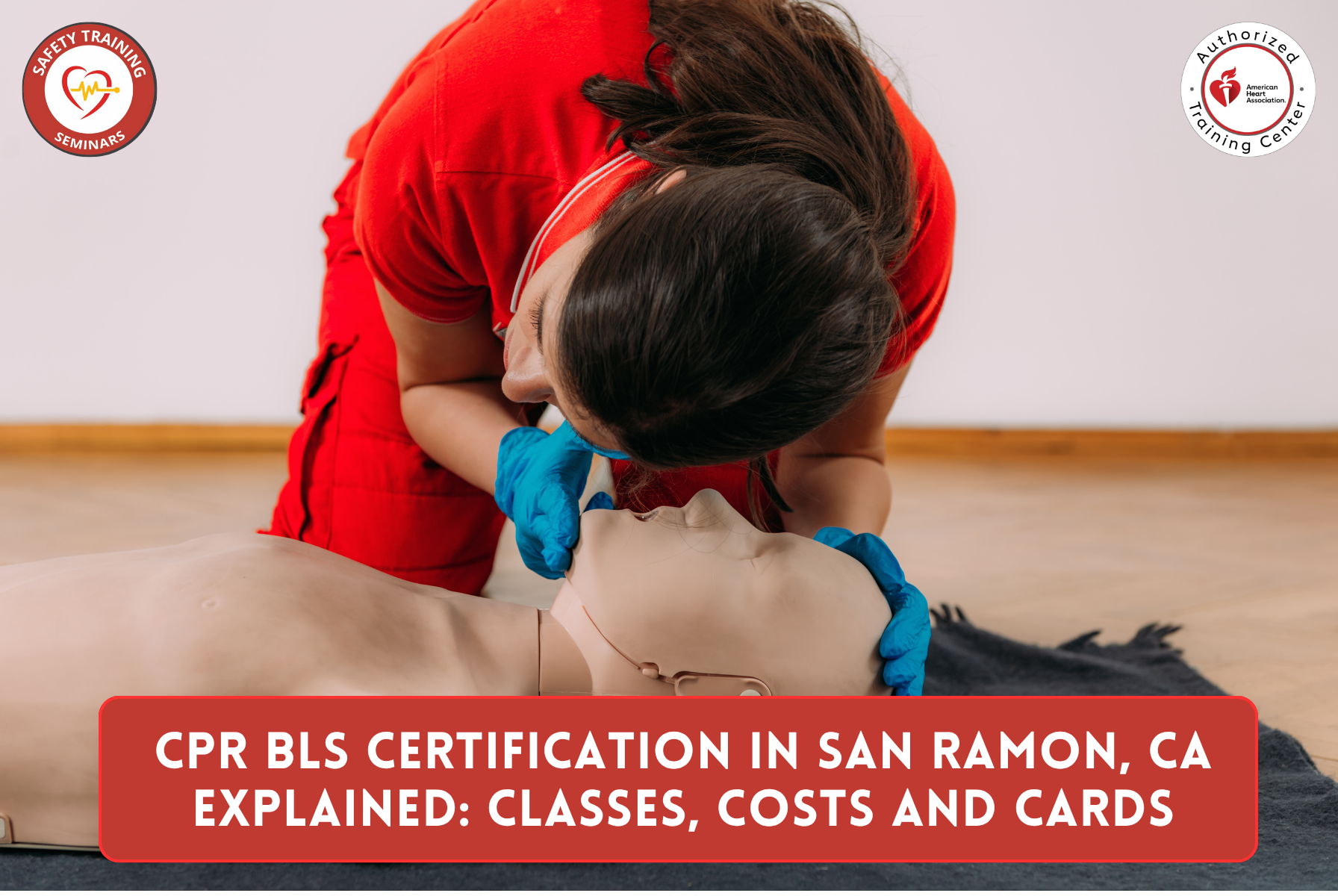
Navigating CPR compliance in Contra Costa County requires understanding which specific course fulfills your professional mandate. Whether you are a newly hired nurse at San Ramon Regional Medical Center, a dental hygienist renewing a license, or a nursing student preparing for clinical rotations, securing the correct Basic Life Support credential ensures your training is accepted without delay.
Understanding the differences between course formats, expected costs, hands-on skill evaluations, and eCard issuance helps you choose the right learning path for your schedule. This guide breaks down the full process for obtaining a BLS CPR certification course in San Ramon, CA, so you can enroll with complete clarity.
Key Takeaway: A professional BLS certification course covers multi-rescuer CPR, bag-valve-mask (BVM) ventilation, and AED operation specifically designed for clinical and public safety environments. Choosing an official blended learning format allows healthcare workers to complete cognitive modules online before attending a short, hands-on skills verification in San Ramon.
What Does a BLS CPR Certification Course Cover?
Basic Life Support (BLS) is the required card for clinical healthcare providers, emergency responders, and allied health professionals. Unlike general public or workplace CPR classes, a BLS course focuses heavily on team dynamics, Advanced Airway support, and rapid defibrillation within medical settings.
The core curriculum emphasizes high-performance resuscitation techniques:
- High-Quality Chest Compressions: Maintaining proper depth, speed, and full chest recoil for adults, children, and infants to maximize perfusion.
- Bag-Valve-Mask (BVM) Ventilation: Operating two-person resuscitation masks to deliver controlled positive-pressure breaths without over-inflating the lungs.
- Automated External Defibrillator (AED) Use: Integrating rapid defibrillation during single-rescuer and team-based resuscitation protocols.
- Team Dynamics & Communication: Coordinating clear roles, closed-loop communication, and smooth compressor switches during cardiac arrest calls.
- Foreign-Body Airway Obstruction: Managing severe choking emergencies in conscious and unconscious adult, pediatric, and infant patients.
Comparing Course Formats: In-Person vs. Blended Learning
Selecting the proper delivery model depends on your learning style and work schedule. Professional training centers offer two primary options to fulfill your certification requirements.
| Feature | Traditional In-Person Class | Blended Learning (eLearning + Skills Check) |
|---|---|---|
| Cognitive Learning | Completed in classroom via video and instructor discussion | Completed online at your own pace prior to class |
| In-Person Requirement | Full session (approx. 3.5 to 4 hours) | Focused hands-on skills check (approx. 45–60 minutes) |
| Written Exam | Taken on paper or tablet at the end of class | Integrated directly into the online module |
| Ideal For | First-time students preferring guided group practice | Busy clinical staff needing quick, flexible scheduling |
| Card Issued | Official eCard upon passing | Official eCard upon passing |
Both options require a live, in-person skills demonstration on feedback manikins to earn a valid provider card. Purely online courses without a physical skills assessment are routinely rejected by California healthcare employers and professional licensing boards.
Breakdown of BLS Certification Costs and Pricing Factors
Understanding what influences course pricing helps you evaluate local providers effectively. Total expenses for a BLS credential generally include two main components: the instructional fee and the official digital completion card.
When reviewing pricing, keep these common factors in mind:
- Class Format: Blended options involve an online key code fee alongside the in-person skills sign-off cost, whereas classroom sessions combine all expenses into a single registration price.
- Card Issuance Fees: Official eCards incur administrative costs directly from national training organizations, which standard providers bundle transparently into their course fee.
- Required Student Manuals: Course guidelines mandate that students have access to current provider manuals during training. Options often include physical textbooks or digital eBooks.
- Employer Reimbursement: Many hospital networks and medical groups offer tuition coverage or continuing education allowances for required certifications. Always check with your HR department before registering.
Who Needs a BLS Card in Contra Costa County?
State licensing boards, hospital systems, and educational institutions establish precise credentialing rules. The BLS provider card is typically mandatory for the following fields:
- Nursing & Medical Staff: Registered Nurses (RNs), Licensed Vocational Nurses (LVNs), Nurse Practitioners, Physicians, and Physician Assistants.
- Emergency Services: EMTs, Paramedics, Firefighters, and Law Enforcement First Responders.
- Dental Teams: Dentists, Dental Hygienists, and Registered Dental Assistants (RDAs) maintaining Board of Dentistry compliance.
- Therapy & Diagnostic Care: Physical Therapists (PTs), Occupational Therapists (OTs), Radiologic Technologists, and Phlebotomists.
- Students & Trainees: Candidates enrolled in nursing, medical, or allied health programs preparing for clinical placements.
If your role involves non-clinical duties, such as daycare management, fitness coaching, or general corporate safety, a standard Heartsaver CPR and First Aid class is usually the correct alternative.
What Happens During the Hands-On Skills Check?
The practical skills assessment tests your physical execution of life support protocols. Instructors utilize real-time feedback manikins that measure compression depth, rate, and recoil to verify clinical competency.
During the session, you will actively demonstrate:
- Single-Rescuer Adult CPR: Delivering 30 compressions to 2 breaths using a pocket mask while attaching an AED promptly.
- Two-Rescuer Team Resuscitation: Utilizing a BVM with a partner, performing smooth compressor transitions every two minutes to prevent fatigue.
- Infant Resuscitation Skills: Demonstrating two-thumb encirling-hands compressions for two-rescuer infant CPR alongside pocket-mask technique.
- Choking Relief Maneuvers: Executing back slaps and chest thrusts for responsive infants and abdominal thrusts for adults.
Wearing comfortable clothing that permits bending, stretching, and kneeling on the floor ensures an optimal testing experience.
Local Access for San Ramon and East Bay Professionals
Situated inside the Bishop Ranch business complex, San Ramon serves as a central hub for healthcare workers commuting across the East Bay and Tri-Valley regions. Clinical professionals working near Norris Canyon Road, Crow Canyon, or the Interstate 680 corridor can easily fit a skills sign-off into their shifts.
Schedules also accommodate healthcare providers traveling from surrounding communities. For instance, clinicians seeking Danville, CA CPR and BLS training or medical personnel comparing Concord, CA BLS class schedules often utilize San Ramon centers to complete required skill checks.
Similarly, students and health workers researching Clayton, CA BLS course options appreciate having direct access to established East Bay training sites.
Completing Your BLS Certification at Safety Training Seminars
Safety Training Seminars provides structured, stress-free certification pathways tailored to healthcare professionals and students throughout Contra Costa County. The facility focuses on efficient skill sign-offs, flexible appointment scheduling, and rapid eCard delivery.
- Local Training Center Address: Safety Training Seminars San Ramon CPR Training Center, Bishop Ranch 1, 6101 Bollinger Canyon Road, Suite 335A, San Ramon, CA 94583.
- Regional Convenience: Serving East Bay clinicians, including those looking for Antioch, CA CPR course schedules or nearby Brentwood, CA BLS certification options.
After completing your in-person skills evaluation, your official digital provider card is issued electronically, allowing you to quickly submit proof of compliance to your employer or school coordinator.
Frequently Asked Questions
How long does an official BLS CPR card remain valid?
BLS certification cards are valid for two years through the last day of the month in which the course was completed. It is best practice to schedule your renewal course at least 30 days prior to your expiration date to maintain continuous clinical credentialing.
Are 100% online BLS cards accepted by California hospitals?
No. Major California hospital networks, nursing boards, and clinical facilities require a hands-on skill evaluation using physical manikins. While you can complete cognitive lessons online, an in-person skills sign-off is mandatory for valid certification.
How quickly will I receive my BLS eCard after class?
Safety Training Seminars issues digital eCards shortly after you pass your in-person skills evaluation. The official eCard is emailed directly to you, allowing immediate downloading, printing, or forwarding to your employer’s compliance portal.
Can healthcare workers from nearby East Bay cities attend training in San Ramon?
Yes. Healthcare providers and students from neighboring communities—including Lafayette, El Cerrito, Hercules, and surrounding areas—regularly attend training in San Ramon due to its accessible location along I-680 and flexible class times.
Securing Your BLS Certification in San Ramon
Staying current with your resuscitation credentials ensures seamless compliance for your job or educational program. By choosing the right training format, preparing for the practical skills check, and verifying employer standards, you can complete your requirement efficiently.
To review upcoming course times, confirm prerequisite materials, or reserve your hands-on skills session, visit the Safety Training Seminars San Ramon course page to take the next step in your professional training.